







Star Trek exists in an interesting fictional place, at the moment. If stories about the future are often mirrors to the present, then Trek has the strange double duty of working two futures at once—one that scratches a nostalgic itch for the series’ classic era (40-60 years ago depending on your preference), and another that’s clearly hoping to imagine a future more in line with our present. That’s the unenviable task that Starfleet Academy finds itself undertaking: establishing a brand new future, 900 years ahead of The Original Series, that allows writers to shake things up for the Federation in ways that feel more true to the current cultural moment we occupy.
Though this era was introduced to audiences in the latter seasons of Star Trek: Discovery, Starfleet Academy is where the powers that be will build it, shaping this new time period of the Trek universe into a (hopefully) stable platform for many new stories to springboard off of. Setting the stage for this period is a cataclysm known as The Burn, in which all active dilithium sources in the galaxy ignited at once, resulting in millions of deaths and the dissolution of the Federation as a cohesive galactic presence. As the Federation rebuilds over a century later—thanks to Discovery’s hard work in assuring another event like The Burn won’t happen again—the reactionary isolation of the more recent generations is in need of correction.
The first and most obvious point of correction on that course is the rebuilding of Starfleet, and the relaunch of the Academy. But doing so points to the difficulty of the intervening years and what they wrought—after all, Starfleet still had officers post-Burn. So where did they come from?
Enter: The War College.
A moment here to fix on the name because, though you likely don’t need reminding (you just read the words), it’s a school dedicated explicitly to war, as a practice. Not a military academy, or a space naval training facility, or even a place for the Federation’s armed forces to convene. It’s a place where you go to learn about war in preparation for being at war with… well, presumably everyone. That’s what the Federation has used as a replacement for Starfleet Academy for over a century.

Upon the rededication of the Academy, we learn that the War College (being both its headmaster and student body) have something of a chip on their collective shoulder over the idea of being supplanted. The show’s goals—as far as we can discern them now, with the first season wrapped—seem to be aiming for either mutual understanding on this front (a “we can’t get along without each other” theme) or a reabsorption back to the old status quo where a War College wasn’t needed for Starfleet to function. But this supposed dichotomy ignores something fundamental in Star Trek’s makeup:
Starfleet is, at its core, a military organization.
It’s a part to that future that rankles for many-a-fan because it seems to betray the core principles of the exercise: Our golden socialist space utopia still relies on having a very big stick and being “unafraid” to use it. Starfleet itself cannot function without hierarchy that places certain people’s judgement and decisions above others. In emergencies and even out of them, rank and file are the rule of the day.
This doesn’t actually have to be a bad thing because, as I mentioned at the start, Star Trek is still ultimately an ongoing exercise in examining where we are and where we would like to be. We can’t imagine our way out of these concepts if we don’t contend with them, and Trek sometimes does a brilliant job on those terms; Deep Space Nine considered what it might feel like to be forced into war in order to avoid galactic servitude to one species; Voyager regularly put Captain Janeway in positions where she had to exert her beliefs over the crew’s because her primary goal was simply getting everyone on board home safe; Picard attempted to wrestle with the reactionary element alive and well within Starfleet in showcasing an incident that led to a ban on synthetic life. We’re aware of the fact that military structures enforce a rigidity that does not align well with everyday decision-making, cooperation, and complexity—hence the frequency with which Starfleet officers and crews go against orders and are rewarded for their insubordination (or have it swept under the rug).
But on its face, the War College isn’t in a great place to help us examine similar ideas. In fact, it seems better situated for helping us separate out the militaristic aspects of the Federation at whim, leaving Starfleet untouched by the ugliness of its imposed stratification and adherence to command—get your codified and sorted nuts out of my freewheeling chocolate, if you will. This draws a similarity to another piece of Federation history that some fans would like to write out of existence: the ever-unpopular Section 31.

Attempts to make the Federation’s icky, invisible espionage wing a ragtag crew of cool kids notwithstanding, Section 31 is a blight on the history of Federation because it (potentially) answers to no one. There are those who find its existence inevitable—it’s noted within Trek itself that many other governments have their own dubious intelligence agencies—but many more who point out that an entire arm of shadow ops that acts autonomously from the rest of its governing body does, in point of fact, go against everything the Federation claims to stand for. The fact that Section 31 purports to be an autonomous agency, and that this fact might be a lie to avoid holding the Federation or Starfleet accountable for its actions, is really the key here. From what we’ve seen so far, the War College is similarly positioned, created during a time when hierarchy became king once again and working together was treated as a luxury.
As it stands, the War College creates absurdly easy—and poorly rendered—rivalries for the Starfleet kids to act out against. Sure, Starfleet demands adherence to certain codes and behaviors, and has been negligent in their duties for over a century, but at least their cadets are encouraged to think for themselves, and use science and empathy and talking to make some of their points! Not like those War College kids, who think they’re better for being… er, physically hardy and disciplined? Not that I assumed the classic “jocks versus nerds” dynamic was truly dead and buried, but Star Trek sure wasn’t the place where I expected it to exhume and shamble about, begging for another chance at life.
In case we are successfully tricked into thinking that this is solely a War College problem, though, I direct you to episode three of the first season, “Vitus Reflux.” Framed as a very tired school-against-school enmity plot, the episode introduces us to a team sport that’s been played by Starfleet cadets for centuries: Calica. While Trek has conceived of its own fair share of odd sci-fi sports—and participated in plentiful average, Earth games like baseball, poker, and darts—Calica is far worse, conceptually speaking. It is nothing but Capture the Flag with unapologetic and bloody war game trappings glorified to the extreme. This is the game we’re told Starfleet has played for ages on its campus. A battle simulation that exists to sharpen cadets for combat, and nothing more.

And all this after a training montage where First Officer Lura Thok subjects the cadets to a brutal physical training regime that contains no visible difference from an army bootcamp. There were ways around this, if the creative team had simply wanted to include the sequence for humor. We could learn that the program is tailored to Thok’s personal and cultural preferences (being both Klingon and Jem’Hadar), and have her adjust it as the episode goes on. We could even grant an aside about how not every cadet is going to be physically able-bodied in the same way, and show what sorts of accommodations they receive in the physical training department. We are given no evidence of this during the training scenes, however, which begs some very uncomfortable questions about Starfleet’s accessibility policies, which, in turn, makes them appear even more militarized. (You can’t serve in military organizations when you achieve certain levels of disability—while we see at least one cadet in a wheelchair on the campus, there are no additional indications that all manner of disability is accounted for, much less welcome, on the quad.)
While the episode does lead to Starfleet Academy winning a prank war against the War College—with a refocus from Captain Ake reminding her cadets that Starfleet’s first goal is to disarm opponents without rising to conflict footing—the questions it opens us up to are never truly resolved. Is the War College meant to be an antagonist that Starfleet Academy can always look good against? Are we relegating military might to one corner of the Federation, away from Starfleet’s more lofty goals, so that it can appear untouched? Are we ever going to contend with the hierarchical nature of Starfleet’s structure in a more meaningful way that leads us out of military pretension?
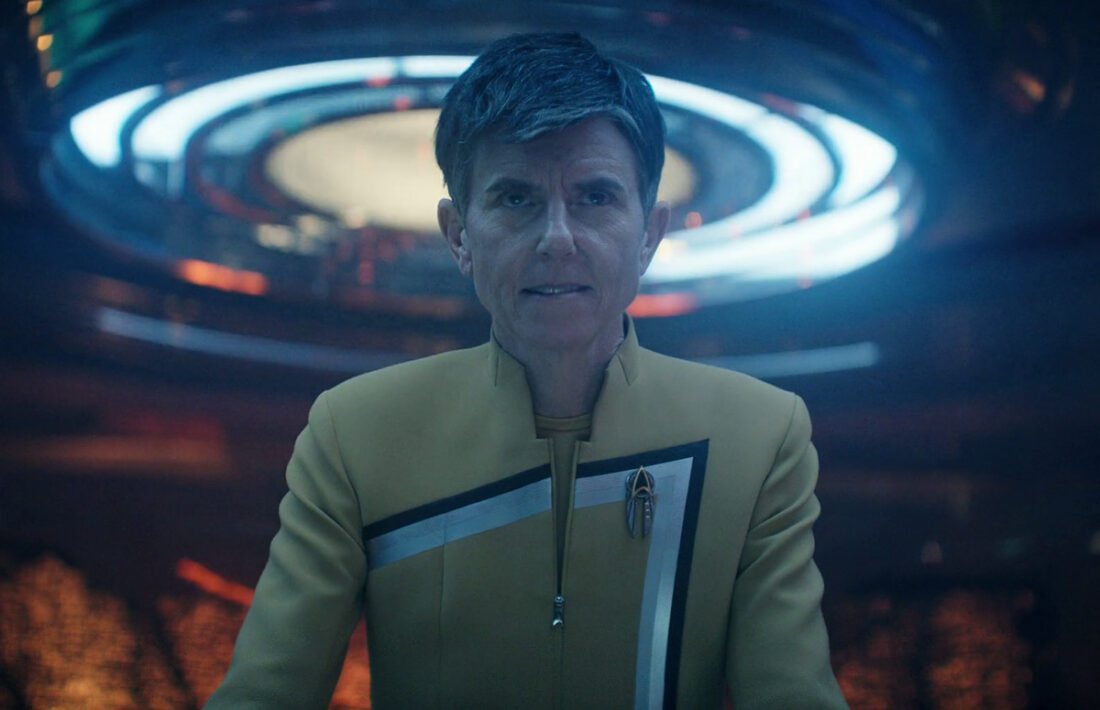
The answer might lie in the show’s leaders: Captain Ake is a teacher first by her actions and commander second. And the season’s finale potentially shows the way forward when Jett Reno takes command of a group of frightened cadets left on board the Athena in an attempt to save the Federation from the antics of Nus Braka. Reno knows precisely how to guide the cadets in a true life-or-death situation without once ever talking down to them, acting more as a project manager than a commanding officer. This is part and parcel of Jett’s personality, but also the personality of her previous commander, the one who should ultimately serve as a guiding light for all future Trek leadership: Captain Michael Burnham of the Discovery.
Captain Burnham had a long road to that bridge chair, and built her command on mutual respect, affection for, and belief in her crew. She was firm in her decisions, but never a tyrant lording over the people in her care. Moreover, she was a deft hand at understanding when disagreement amongst her crew was coming from genuine objection and knowledge, or personal grievance and personality quirks. She was good at people, as the parlance goes, and it made her a far less militaristic commander than many of her forbears and contemporaries.
All of which is to say that noting our hierarchical present isn’t at fault here… but failing to imagine ways around and out of it is. We can do better in how we imagine the structure of governance and teamwork, and Star Trek is an ideal playground to begin seeding those ideas. Starfleet Academy is a great series to give those thoughts a go.
With these ruminations in mind, I remain uneasy with the War College’s creation and placement in the current Trek milieu. We have upcoming seasons to find out what the writers will make of it—but imagining the future demands more than a siloing of every uncomfortable concept. If we don’t engage with the idea of the Federation creating an entire college dedicated to the worst of our impulses, we’ll never be able to leave it behind.

“after all, Starfleet still had officers post-Burn. So where did they come from?
Enter: The War College.”
Maybe I’m missing something, but having watched Tilly teaching cadets on Discovery, I assumed Starfleet officers came from Starfleet Academy, which was no longer on an Earth that had left the Federation after the Burn. The United Earth Defense Force, on the other hand, might very well have had a War College.
As for why the show introduced the War College… well, it fits with the United Earth Defense Force in terms of worldbuilding, and — probably more importantly for stories focusing on the cadets — it gives the kids a rival school.
Discovery established that the Academy had been closed since the Burn. It was reopened at the start of season 4, and that’s when Tilly began teaching cadets. Starfleet Academy is set a few years later, with the Academy returning to its traditional San Francisco campus after several years of operation at the Federation Headquarters space station.
The War College is not United Earth, but Starfleet. It’s how Starfleet officers were trained while the Academy was shuttered.
“Picard attempted to wrestle with the reactionary element alive and well within Starfleet in showcasing an incident that led to a ban on synthetic life.”
That wasn’t Starfleet, it was the Federation’s civilian government, under political pressure from member worlds that threatened to secede. Despite what people often assume, Starfleet doesn’t govern the Federation or make its laws.
As for “war college,” Wikipedia says it’s a common term for a senior military academy where veteran officers can received advanced tactical and strategic training — sort of a military graduate school, I guess, making it an odd term to use for a cadet school, but I guess meanings can shift over time. I take the “war” part as a traditional usage rather than a literal mission statement.
The idea behind the War College is valid — to contrast the more defensive, survivalist turn the surviving remnant of the Federation took post-Burn with the more idealistic “old Starfleet” philosophy that the reopened Academy represents — but they haven’t made good use of it yet. I would’ve rather seen a season finale that was less about “Oh no, some petty space pirate is somehow able to blow up the entire Federation” and more about paying off the tension they set up between the Academy and the College, their competition over the same grounds and their respective right to occupy them.
And yes, I agree about Calica and Lura Thok’s drill-instructor tactics. It makes no sense to include those as Starfleet practices if the idea is to contrast with the War College.
It’s because they let the Jem hadar in.
I’m surprised there was no Species 8472 at the Academy!!
They can shapeshift, so maybe there are.
We knew that Starfleet had advanced combat and tactile training as far back as Ro Laren’s period at Advanced Tactical Training. A program like that is a war college. In this case the post-Burn Starfleet combined the Academy with existing advanced training and created the War College to deal with the fact they were stuck being space police with ever shrinking resources and ever increasing numbers of people trying to kill them.
The fact the War College continues to exist looks to be a matter of inertia since we haven’t seen anything at the training level that is markedly different from the Academy. They’re even on the same academic calendar. (That and a merger would make a good season 4 subplot.)
And for the record the purpose of tactical and strategic officer training is to have a force that can fight Anyone, not one that can fight Everyone. Anyone means you’re picking using violence as a tool. Everyone means you’re using violence as the only tool. Any officer corp in history that embraced the second mindset was a disaster.
What’s bugged me about the War College is that it seems to be long-established and to have always been on Earth, even though Earth left Starfleet and cut themselves off from the rest of the galaxy. And then the Federation came back to Earth and plunked its Academy right down next to the War College which appears to have cadets of varying species and a direct connection to Starfleet and a dog in the Who’s Making the REAL Starfleet Officers? fight. But none of that makes sense to me, maybe I’m missing something. Anyway, add my “Why is War College?” in with Emmet’s very valid points and it really is the shakiest part of a surprisingly good show.
EDIT TO ADD — I re-read Christopher L Bennett’s explanation and it helps, but I got no sense at all that the War College had been anywhere other than Earth.
I also initially thought that the War College had been on Earth already, but Memory Alpha (the Trek wiki) says that both Starfleet Academy and the War College set up shop on the old San Francisco campus at the same time. Still, the show could have conveyed that more clearly.
I haven’t seen anyone mention the MAKOs in “Enterprise.” They were a militaristic branch of Starfleet’s beginnings, that were, I assume, later incorporated into Starfleet as a whole (Security is a legit branch of Starfleet).
The MACOs weren’t Starfleet at all, but the United Earth marines, while Earth Starfleet was more like NASA crossed with the Coast Guard. But yes, the implication did seem to be that the MACOs were folded into the Federation Starfleet as the security division.
One thing that often gets misunderstood in the “is Starfleet military?” debates is that there’s a difference between being military and being combat-oriented. There are military organizations with non-combat missions, like the Coast Guard. There are militaries that are exclusively for defense and never for war, like the Japan Self-Defense Force. Even militaries that do fight wars also have many peacetime missions such as science, diplomacy, large-scale engineering projects, disaster relief, basically everything Starfleet does. It’s not that the War College is military and Starfleet isn’t; they’re both militaries, with ranks and uniforms and discipline and so forth, but they have different mission priorities. Starfleet trains to be a peacetime military except when necessary, while the War College prepares only for the “when necessary.”
It wasn’t a Socialist utopia. It was a resource abundant Liberal utopia.